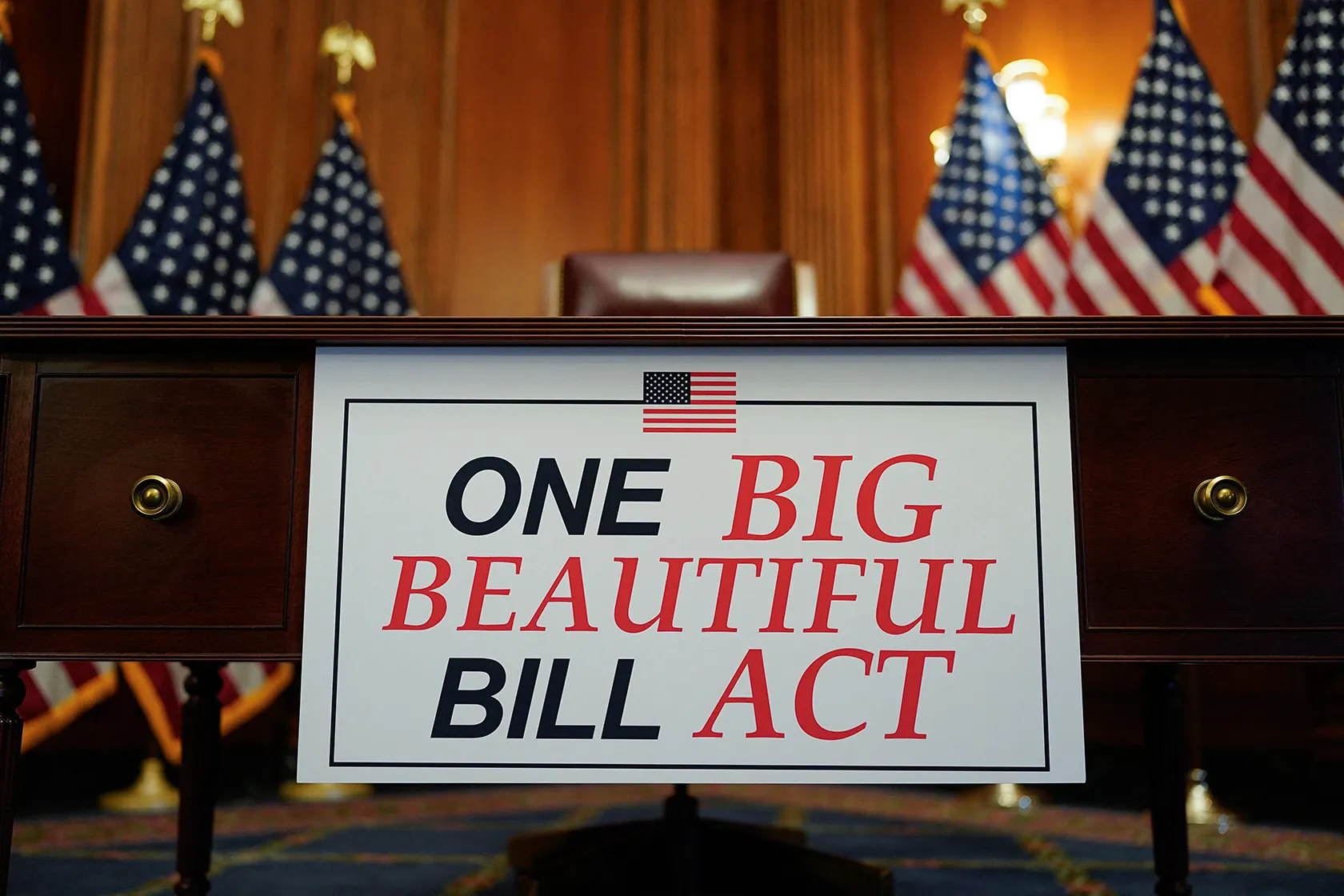
Understanding the One Big Beautiful Bill
On July 4th, President Trump signed into law the One Big Beautiful Bill (OBBB), which introduces significant tax reforms aimed at supporting small businesses and working families. The law was enacted on July 4, 2025 as Public Law 119-21, and the IRS now refers to it as the Working Families Tax Cuts, so that is the name you will see on irs.gov.
This article summarizes the key components of the law, with a timeline of when each change applies, a checklist for business owners and a summary table at the bottom of the post. Updated November 2026 with the IRS’s published figures for 2026.
For Businesses
1. Restoration of 100% Bonus Depreciation
The OBBB makes 100% bonus depreciation permanent for qualified property acquired after January 19, 2025. This allows businesses to immediately deduct the full cost of eligible assets, such as machinery, equipment and vehicles, for federal tax purposes instead of depreciating them over time. For the first tax year ending after January 19, 2025, a business can elect 40% bonus depreciation instead of 100%. For how this applies to equipment acquired with a business, see the tax benefits of buying a business.
The section 179 expensing limit also rose from $1,000,000 to $2,500,000 for tax years beginning after December 31, 2024, reduced dollar for dollar once section 179 property placed in service in the year exceeds $4,000,000; both amounts are indexed for inflation after 2025. State rules differ: check whether your state follows federal bonus depreciation before planning a purchase around it. For deductions specific to restaurants, see tax deductions for restaurant owners.
2. Immediate Expensing of U.S.-Based R&D Costs
For tax years beginning after December 31, 2024, businesses can again deduct domestic research and experimental (R&E) expenditures in the year they are paid or incurred, under new section 174A, or elect to amortize them over at least 60 months. Foreign R&E is still amortized over 15 years. Two transition rules from IRS Revenue Procedure 2025-28 matter for 2022–2024 costs:
- A small business taxpayer (average annual gross receipts of $31 million or less for the three prior years, for a tax year beginning in 2025) can elect to apply the new rule retroactively to tax years beginning after December 31, 2021.
- Any business with unamortized domestic R&E from 2022–2024 can elect to deduct the remaining amount in full in its first tax year beginning after December 31, 2024, or spread it over that year and the next.
3. Section 199A Deduction Made Permanent
The Section 199A pass-through deduction has been made permanent, with no change to the current 20% deduction percentage. For tax years beginning after December 31, 2025, the bill expands the limitation phase-in range from $50,000 for single filers ($100,000 for married filing jointly) to $75,000 ($150,000 for married filing jointly). It also creates a minimum deduction of $400 for taxpayers with at least $1,000 of qualified business income from businesses in which they materially participate; both amounts are indexed for inflation after 2026.
4. Pass-Through Entity Tax Deduction Preserved
The final law does not change the deduction for state pass-through entity taxes (PTET). Under IRS Notice 2020-75, a partnership or S corporation that pays state income tax at the entity level deducts it in computing its own taxable income, so it doesn’t count toward the owners’ individual SALT cap. For pass-through businesses in states with a PTET election, this combined with the higher SALT cap (below) can provide a double benefit.
5. Section 1202 Qualified Small Business Stock (QSBS) Enhancement
The OBBB keeps the 100% exclusion of gain on QSBS held at least 5 years and adds a 50% exclusion for stock held at least 3 years and a 75% exclusion for stock held at least 4 years. These rules apply to stock acquired after July 4, 2025. For that stock, the per-company cap on excluded gain rises from $10 million to $15 million (indexed for inflation after 2026), and the gross-asset limit for a qualified small business rises from $50 million to $75 million.
6. Higher 1099 Filing Threshold
For payments made after December 31, 2025, the Form 1099 reporting threshold for payments such as contractor fees and rent rises from $600 to $2,000, indexed for inflation after 2026. Businesses issuing payments to contractors or service providers should update their vendor setup and year-end process for the new threshold.
7. Form 1099-K Threshold Restored to $20,000
For payment apps and online marketplaces, Form 1099-K reporting is again required only when payments to a seller exceed $20,000 and the number of transactions exceeds 200, instead of the $600 threshold that had been scheduled.
8. Employee Retention Credit Cut-Off
No Employee Retention Credit or refund for the third or fourth quarter of 2021 can be allowed after July 4, 2025 unless the claim was filed by January 31, 2024. Our employee retention credit guide explains what this means for pending claims.
9. Workplace Benefits
Employers can permanently pay up to $5,250 a year of an employee’s student loans tax-free through a qualified educational assistance program (a combined limit with other educational assistance, indexed after 2026). The paid family and medical leave credit is permanent and expanded, and from 2026 the employer-provided childcare credit rises to a maximum of $500,000 ($600,000 for eligible small businesses).
For Individuals
1. Personal Tax Rates Made Permanent
The OBBB makes the 2017 rate structure (10%, 12%, 22%, 24%, 32%, 35% and 37%) permanent, with an additional inflation adjustment to some of the lower bracket amounts. For 2026, the 37% rate applies to taxable income over $640,600 (single) or $768,700 (married filing jointly), and the 10% rate to income up to $12,400 (single) or $24,800 (joint).
2. Increase in Standard Deduction
The standard deduction has been increased and is indexed for inflation:
- 2025: $15,750 for single filers, $31,500 for married couples filing jointly, $23,625 for heads of household
- 2026: $16,100 for single filers, $32,200 for married couples filing jointly, $24,150 for heads of household
3. Child Tax Credit Expansion
The Child Tax Credit increases to $2,200 per qualifying child starting in 2025, indexed for inflation after 2025.
4. SALT Deduction Cap Increase
The cap on the state and local tax (SALT) deduction rises from $10,000 to $40,000 for 2025, $40,400 for 2026, and then by 1% a year through 2029, before returning to $10,000 in 2030. The cap is reduced by 30% of modified adjusted gross income over $500,000 for 2025 ($505,000 for 2026), but never below $10,000.
5. Deduction for Overtime Pay
From 2025–2028, a deduction of up to $12,500 (or $25,000 for joint filers) is allowed for qualified overtime compensation.
- Phaseout thresholds: $150,000 (single) / $300,000 (joint)
- Covers only the premium part of overtime required under the Fair Labor Standards Act (for example, the “half” of time-and-a-half)
- Overtime must be reported on a W-2, 1099 or other statement; the IRS provided transition relief for 2025 reporting
6. Deduction for Tip Income
From 2025–2028, a deduction of up to $25,000 is available for qualified tips, whether or not you itemize.
- Phaseout thresholds: $150,000 (single) / $300,000 (joint)
- To qualify, tips must be:
- Voluntary cash or charged tips from customers, including shared tips
- Received in an occupation that customarily and regularly received tips on or before December 31, 2024; Treasury and the IRS have issued proposed regulations listing those occupations
- Not available to people self-employed in, or employed by, a specified service trade or business
- For self-employed people, the deduction can’t exceed the net income of the business where the tips were earned
7. Enhanced Standard Deduction for Seniors
Taxpayers aged 65 and older qualify for an additional deduction of $6,000 ($12,000 for a married couple if both qualify), whether or not they itemize.
This deduction starts phasing out at $75,000 of modified adjusted gross income for a single taxpayer and $150,000 for joint filers. It applies for 2025 through 2028.
8. Interest on Domestic Auto Purchases
From 2025–2028, taxpayers may deduct up to $10,000 a year of interest on a loan taken out after December 31, 2024 to buy a new, personal-use car, SUV, van, pickup or motorcycle that had its final assembly in the United States.
- Phaseout thresholds: $100,000 (single) / $200,000 (joint)
- The vehicle’s VIN must be included on the return; lease payments don’t qualify
- Vehicles used in a business follow the business rules instead; see our business vehicle deduction guide
9. “Trump Accounts” for Children
A new tax-advantaged savings account for children. Contributions began on July 4, 2026.
- Contributions of up to $5,000 per year from individuals; employers can contribute up to $2,500 per year, excluded from the employee’s income
- A one-time $1,000 federal contribution for an eligible child: a U.S. citizen born after December 31, 2024 and before January 1, 2029
- Funds are invested in certain U.S. stock index funds; money generally can’t be withdrawn before the year the child turns 18, after which the account is treated much like a traditional IRA
10. Clean Energy Credits
The OBBB ends the following energy credits early:
- New and used clean vehicle credits and the commercial clean vehicle credit: not allowed for vehicles acquired after September 30, 2025
- Residential clean energy credit: not allowed for expenditures made after December 31, 2025
- Energy-efficient home improvement credit: not allowed for property placed in service after December 31, 2025
- New energy-efficient home credit (for home builders): not allowed for homes acquired after June 30, 2026
11. Charitable Contributions
Beginning in 2026, taxpayers who don’t itemize can deduct up to $1,000 ($2,000 for married filing jointly) of cash contributions to eligible charities. Donations to donor-advised funds and supporting organizations don’t qualify.
When each OBBB change applies
| Date | What starts or ends |
|---|---|
| Property acquired after Jan. 19, 2025 | 100% bonus depreciation (permanent) |
| Tax year 2025 | Higher standard deduction; $2,200 child tax credit; $40,000 SALT cap; tips, overtime, seniors and car loan interest deductions begin; $2.5M section 179 limit; domestic R&E expensing |
| Stock acquired after July 4, 2025 | Tiered QSBS exclusion (3, 4 and 5 years), $15M cap, $75M gross-asset limit |
| Vehicles acquired after Sept. 30, 2025 | No clean vehicle credits |
| Payments made in 2026 | $2,000 Form 1099 threshold |
| Tax year 2026 | Wider QBI phase-in range and $400 minimum deduction; non-itemizer charitable deduction; larger childcare credit; $40,400 SALT cap |
| July 4, 2026 | Trump account contributions begin |
| After 2028 | Tips, overtime, seniors and car loan interest deductions end |
| 2030 | SALT cap returns to $10,000 |
What business owners should do now
- Time equipment purchases. With 100% bonus depreciation permanent, the question is no longer “before it phases out” but which year the deduction is worth most to you.
- Revisit R&D costs from 2022–2024. Decide whether to accelerate the remaining amortization, or, if you are a small business taxpayer, whether amending prior years is worth it. Startups should also look at the research credit; our guide to startup cash flow scenario planning shows where these items fit in a forecast.
- Update 1099 procedures for the $2,000 threshold on 2026 payments.
- Check your PTET election if you own a pass-through in a state that offers one, alongside the higher SALT cap.
- Review payroll reporting for tips and overtime, which employers must now report separately.
- If you are raising money, the new QSBS rules make C corporation stock issued after July 4, 2025 more attractive for founders and investors.
The IRS’s full list of provisions is on its Working Families Tax Cuts page for businesses.
OBBB tax rules comparison
| Provision | Prior rule | Post-OBBB rule |
|---|---|---|
| Bonus depreciation | Phasing down: 2024: 60%, 2025: 40%, 2026: 20%, 2027: 0% | 100% permanent for property acquired after Jan. 19, 2025 |
| Section 179 limit | $1,000,000 (before inflation adjustments) | $2,500,000, phase-out from $4,000,000, indexed after 2025 |
| R&D expensing | 5-year amortization (domestic), 15-year (foreign) since 2022 | Immediate expensing restored for domestic R&E from 2025; foreign still 15 years |
| Section 199A pass-through | 20% deduction set to expire after 2025 | Permanent, wider phase-in from 2026 and $400 minimum |
| Pass-through entity tax | Deductible at entity level (Notice 2020-75) | No change |
| Section 1202 QSBS | 100% exclusion after 5 years, $10M limit | Tiered 50% (3 yr), 75% (4 yr), 100% (5 yr), $15M limit, for stock acquired after July 4, 2025 |
| 1099 filing threshold | $600 | $2,000 for payments after 2025, indexed after 2026 |
| 1099-K threshold | $600 scheduled | Over $20,000 and over 200 transactions |
| Personal tax rates | Set to expire after 2025 | Made permanent |
| Standard deduction | $15,000 single / $30,000 joint (2025) | $15,750 / $31,500 (2025); $16,100 / $32,200 (2026) |
| Child tax credit | $2,000 per child | $2,200 per child starting 2025, indexed |
| SALT cap | $10,000 | $40,000 (2025), $40,400 (2026), +1% a year to 2029; reduced above $500,000 MAGI |
| Overtime pay deduction | New | Up to $12,500 single / $25,000 joint (2025–2028) |
| Tip income deduction | New | Up to $25,000 (2025–2028) |
| Senior deduction | Additional standard deduction only | Plus $6,000 per person 65+ (2025–2028), phases out from $75,000 / $150,000 |
| Auto loan interest | New | Up to $10,000 for U.S.-assembled personal vehicles (2025–2028) |
| Trump accounts | New | $5,000 annual contributions; $1,000 federal contribution for children born 2025–2028 |
| Clean energy credits | Various credits available | Ended early (Sept. 30, 2025 to June 30, 2026, by credit) |
| Charitable deduction | Itemizers only | $1,000 single / $2,000 joint for non-itemizers (2026+) |
Questions about how these changes affect you? See how we help with small business taxation, or book a call with our team.
Frequently asked questions
What is the OBBB (One Big Beautiful Bill)?
The OBBB is a tax law signed by President Trump on July 4, 2025 (Public Law 119-21), which the IRS now calls the Working Families Tax Cuts. It introduces significant tax reforms aimed at supporting small businesses and working families, including permanent 100% bonus depreciation, immediate expensing of U.S.-based R&E costs, a permanent Section 199A deduction, a higher standard deduction and a larger SALT deduction cap.
What are the main OBBB tax changes for businesses?
It permanently restores 100% bonus depreciation for qualified property acquired after January 19, 2025, raises the section 179 limit to $2.5 million, allows domestic R&E costs to be deducted in the year incurred, makes the 20% Section 199A deduction permanent, leaves the pass-through entity tax deduction unchanged, expands the QSBS gain exclusion, and raises the 1099 reporting threshold from $600 to $2,000 for payments made after 2025.
What is the standard deduction under the OBBB?
For 2025, the standard deduction is $15,750 for single filers and $31,500 for married couples filing jointly; for 2026 it is $16,100 and $32,200. Taxpayers aged 65 and older can also take an additional $6,000 deduction for 2025 through 2028, which starts phasing out at $75,000 of modified adjusted gross income for a single taxpayer and $150,000 for joint filers.
What does the OBBB do to tax brackets?
It makes the rates that were set to expire after 2025 permanent: 10%, 12%, 22%, 24%, 32%, 35% and 37%, with an additional inflation adjustment to some lower bracket amounts. For 2026, the 37% rate starts above $640,600 of taxable income for single filers and $768,700 for joint filers.
When do OBBB provisions expire?
Many are permanent, including 100% bonus depreciation, the Section 199A deduction and the individual tax rates. Others are temporary: the higher SALT cap runs through 2029 and returns to $10,000 in 2030; the overtime pay, tip income, auto loan interest and senior deductions run from 2025 through 2028.
Is the OBBB the same as the Working Families Tax Cuts?
Yes. The IRS refers to the law signed on July 4, 2025 as the Working Families Tax Cuts, and its guidance pages on irs.gov use that name. The provisions are the same ones described in this article.